What key is this song in? How to find a song’s key and BPM
"What key is this song in?" and "what BPM is this song?" are two of the most-searched music questions there are — asked by DJs planning a harmonic mix, producers building a track around a loop, and musicians who just want to play along. The good news: both answers take seconds with the right tool, and a few minutes once you learn the by-ear method.
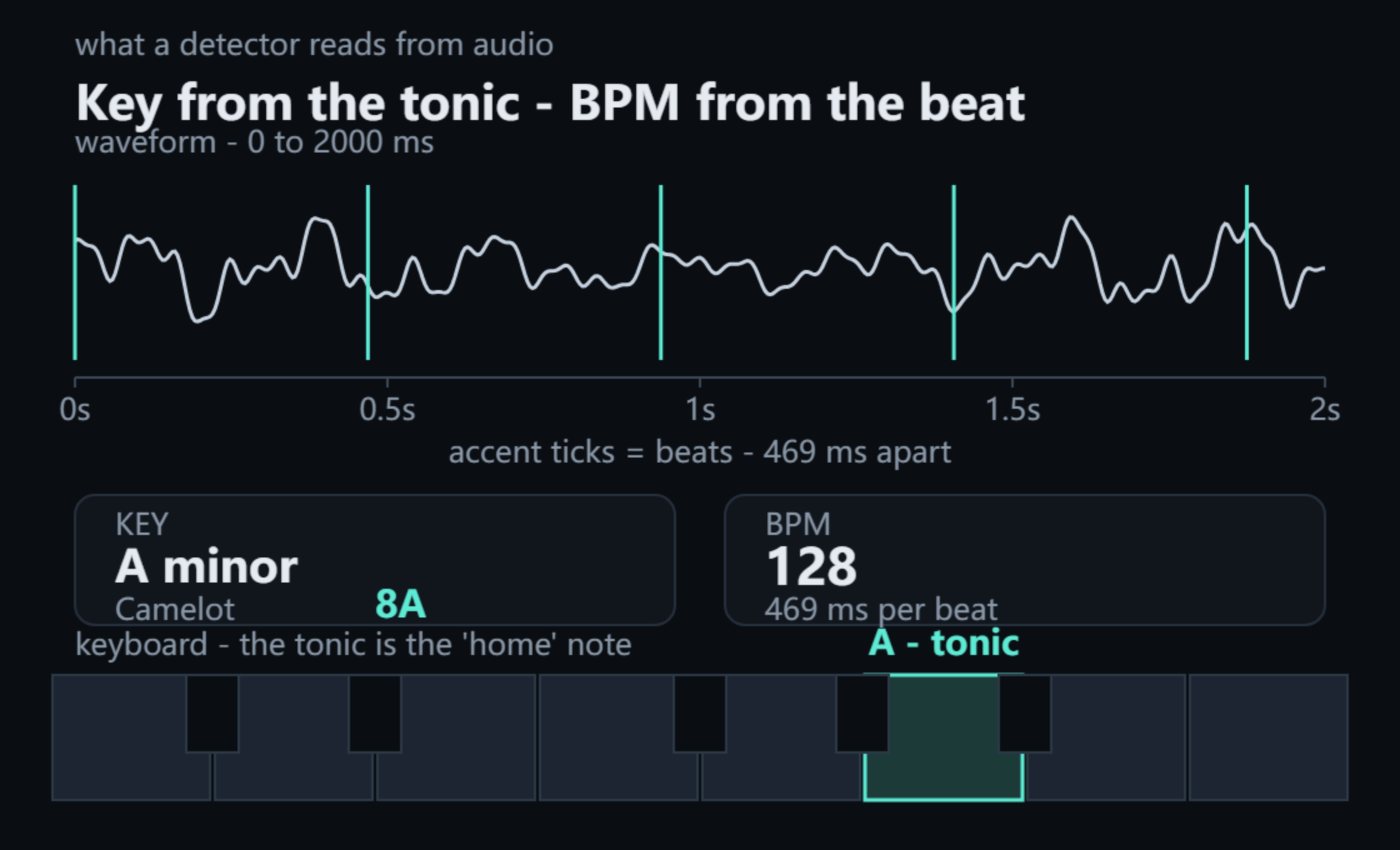
The fast answer: drop the file into a finder
If you have the song as a file (MP3, WAV, FLAC, M4A), a web-based key and BPM finder is the quickest route. Upload the track and you get its musical key, major/minor mode, and tempo back in seconds — no signup, no account. Songprint runs two free tools for exactly this:
Song Key Finder — key, mode and Camelot code for harmonic mixing
BPM Finder — the tempo of any song, free
The catch: finders need the song as a file. A track playing on YouTube or in Spotify is not a file — you either download it (where the platform allows) or record what your device plays and analyze the recording.
Find the key by ear
The by-ear method works on anything you can hear — a YouTube video, a vinyl rip, a song on the radio. It has two steps:
- Find the tonic — the "home" note. Play single notes over the song on a keyboard or instrument until one sounds settled and resolved, especially at the end of phrases. The first or loudest note is not necessarily the tonic; bass lines often emphasize it at phrase endings.
- Check the mode — major or minor. Compare the melody and harmony against the tonic: the third of the scale is what makes a key sound bright (major) or dark (minor).
Two caveats from experienced teachers: an intro or verse may sit in a different harmonic area than the chorus, so check more than one section before committing — and a song can genuinely change key mid-track, so "the key" is sometimes a simplification.
Find the BPM
BPM is just beats per minute — how many times per minute you would naturally tap your foot. Three ways to get it:
- Tap tempo: tap along on every beat for 10–20 taps and let the tool average the gaps. Tap the pulse you would count along to, not every hi-hat or arpeggio note.
- Manual counting: count beats for 15 seconds and multiply by 4 (or count 30 seconds and double). Rough, but closer than people expect.
- Automatic detection: tempo detectors measure the spacing between drum hits and note onsets — fast and accurate on steady, drum-led productions.
Detection struggles where the pulse is ambiguous: rubato ballads, swing and shuffle grooves, busy syncopation, and ambient intros with no clear beat. For those, tap tempo or counting beats machine detection every time.
Why two finders can disagree
If you run the same song through two tools and get different answers, it is usually one of two known ambiguities — not a bug:
- Relative minor vs. major: A minor and C major share the exact same key signature, so "C major" and "A minor" can both be defensible answers for the same track. Listen for which note resolves as home.
- Half-time vs. double-time: a track detected at 140 BPM might feel like 70 BPM depending on which pulse you tap. Both numbers describe the same audio — pick the one that matches the genre and your use case.
So: have the file? Use a finder and be done in seconds. Only have your ears? Find the home note, check major vs. minor, then tap the beat — and when two answers both sound right, trust the one that fits how the song actually feels.
Check a song now
Free AI music detection — 3 checks a day, no signup.